


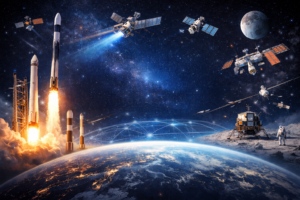
2026: A Breakout Year for Launch, Data, and Orbital Infrastructure
The pace of change in the space industry continues to accelerate, and 2026 is shaping up to be a defining year. Launch rates are climbing, spacecraft capabilities are expanding, and orbits are becoming more populated and more strategically important. Together, these trends are driving a step change in how space systems are designed, deployed, and operated.
Launch Cadence Hits a New Gear
SpaceX has already reset expectations for launch frequency, setting record after record over the past several years. That momentum is expected to continue into 2026. At the same time, new and maturing launch vehicles from Blue Origin, Rocket Lab, India, and China are coming online or scaling operations. The combined effect is a dramatic increase in global launch capacity, positioning 2026 as a likely record year for orbital launches.
This higher cadence is reducing barriers to orbit, shortening deployment timelines, and enabling more ambitious mission architectures. It also means more spacecraft entering orbit faster than ever before.
More Satellites, More Orbits, More Data
As launch capacity grows, so does the volume of data generated in space. In 2025, the first orbital data center was launched, signaling a shift toward spacecraft with onboard processing and compute capabilities. That trend accelerates in 2026 as satellites increasingly act not just as sensors, but as intelligent platforms capable of filtering, analyzing, and acting on data in orbit.
These missions will span multiple orbital regimes. Low Earth orbit will remain active, but growth is also expected in medium Earth orbit and cislunar space. Each orbit introduces unique operational and connectivity challenges, increasing demand for reliable, high-capacity data links between Earth and space and demands on spectrum.
A More Diverse Spacecraft Ecosystem
Through 2025, launch manifests were dominated by broadband constellations and Earth observation missions. While those categories will continue to grow, 2026 marks a broadening of the spacecraft ecosystem. New mission types include orbital data centers, rendezvous and proximity operations, small satellites deployed across LEO, orbital transfer vehicles, and early commercial space station infrastructure.
Additional growth areas such as IoT connectivity and signals intelligence further diversify the mix of spacecraft on orbit. This diversity increases operational complexity and places a premium on flexible, scalable ground and communications infrastructure.
The Space Race Accelerates
Geopolitical dynamics are playing an increasingly central role in space activity. The United States, China, and allied nations are deploying more spacecraft to support national defense objectives while simultaneously advancing lunar and deep-space ambitions. Space is now firmly recognized as a strategic domain, alongside land, sea, air, and cyber.
This shift is driving higher launch volumes, more mission-critical systems, and greater emphasis on resilience, redundancy, and global coverage.
Large-Scale Communications Constellations Expand
Communications remains one of the fastest-growing segments of the space economy. Starlink continues to scale at an unprecedented rate, direct-to-device services are gaining traction, Amazon’s LEO constellation is progressing, and sovereign constellations are expanding as nations seek independent space-based connectivity.
Together, these initiatives are reshaping the global communications landscape and significantly increasing demand for ground infrastructure capable of supporting frequent contacts, high data volumes, and diverse mission requirements. All of these communication initiatives will require spectrum and we can expect more contention around the licensing, procurement and use of spectrum on orbit. We will also see optical play an increasingly large role in intersatellite communications as well as direct to Earth.
Looking Ahead
By 2026, space will be more active, more crowded, and more data-intensive than ever before. Higher launch cadence, more capable spacecraft, and expanding orbital regimes are redefining what it takes to operate successfully in space. In this environment, connectivity between Earth and orbit is no longer a supporting function—it is foundational.
As the industry scales, the ability to reliably move data across orbits and down to Earth will be a critical enabler of mission success in the years ahead.