


By Sean McClinton
Coming out of Seattle Space Week, I’ve been thinking about why Seattle and space seem to fit so naturally together.
Seattle Space Week, organized by Space Northwest, brought together people from across the region’s space community—large companies and startups, entrepreneurs and investors, engineers, government leaders, and others who are helping shape what the space industry is becoming.
RBC Signals was fortunate to be part of it. Our President & CEO, Ron Faith, spoke during the week, and our team had the opportunity to connect with people from across the industry.
But the week also highlighted something bigger: Seattle has become one of the most important space regions in the world, and that didn’t happen by accident.
In a lot of ways, space brings together things Seattle has been doing for a very long time.
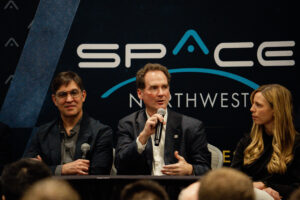
RBC Signals President & CEO Ron Faith speaking at Space Northwest Symposium
We Know How to Build Things
Seattle’s aviation history obviously starts long before today’s commercial space industry.
For generations, Boeing and the aerospace industry around it built an enormous base of engineering, manufacturing, and technical talent in the region. There are people here who know how to design complicated things, manufacture them, test them, and make them work reliably.
That matters in space.
But Seattle’s story isn’t just aerospace.
Over the last several decades, the region also became one of the world’s centers for software, cloud computing, communications, and large-scale technology infrastructure.
Those two histories are now beginning to converge.
The modern space industry isn’t just about building rockets and satellites. Increasingly, it’s about software, networks, data, cloud infrastructure, communications, autonomy, and computing.
Those happen to be things Seattle knows pretty well.
We’re Building a Lot of the Satellites, Too
There is a statistic that really puts the scale of Seattle’s role in space into perspective.
Nearly two-thirds of the active satellites orbiting Earth today were built in the Seattle area, largely because of SpaceX’s Starlink manufacturing operation in Redmond. Amazon Leo is also ramping up satellite manufacturing just down the road in Kirkland.
It’s pretty remarkable when you stop and think about it.
A significant percentage of the objects flying around Earth were built within a relatively small area east of Seattle.
And from an RBC Signals perspective, there is another interesting part of that story.
Every One of Those Satellites Needs to Communicate.
Putting something into orbit is only part of the equation. Satellites need telemetry, tracking, and command to operate. They need to move data back to Earth. And as satellites become more capable and the number of spacecraft in orbit continues to grow, the communications infrastructure supporting them has to grow too.
That’s the part of the space economy RBC Signals works on every day.
We provide satellite operators access to a global network of ground stations and communications infrastructure without requiring each operator to build that network themselves.
In some ways, that model reflects Seattle’s technology history just as much as its aerospace history. Shared infrastructure, global networks, software-defined systems, and services that can scale with demand are ideas that are very familiar here.
So there is something fitting about RBC Signals being built in the same region that is building so many of the satellites we’re helping connect.
But Companies Alone Don’t Make an Ecosystem
One of the things Seattle Space Week reinforced for me is that having a lot of space companies in one place isn’t quite the same thing as having a space ecosystem.
An ecosystem requires connections.
Founders need to meet customers and investors. Startups need access to experienced people who have built companies before. Established companies need suppliers and talent. Universities need connections into industry. Government needs to understand what the industry needs to grow.
And sometimes people simply need opportunities to get in the same room.
That’s part of what Seattle Space Week is about.
It’s also part of why RBC Signals has been involved in the broader effort to strengthen the region’s space community.
Sean McClinton, who works with RBC Signals, is also a co-founder of Space Northwest, the organization behind Seattle Space Week, and is helping lead STAGE, Space Northwest’s first accelerator program.
STAGE is focused on a relatively simple idea: if we want more great space companies to come out of the Pacific Northwest, we need to help entrepreneurs connect with the customers, capital, mentors, partners, and resources that can help them succeed.
Because Seattle’s opportunity isn’t simply to be a place where space companies happen to be located.
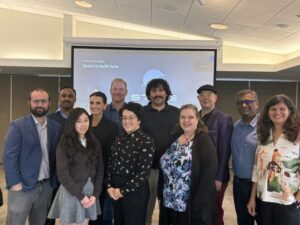
RBC Signals Head of Business Operations Sean McClinton with the new Space Northwest Accelerator STAGE cohort
The opportunity is to make this one of the best places in the world to build a space company.
Seattle’s Next Chapter
Seattle has gone through a number of economic and technological chapters.
Timber. Maritime commerce. Aviation. Software. Cloud computing. E-commerce.
Space feels less like a departure from that history and more like a continuation of it.
It combines our aerospace heritage with software, cloud computing, communications, advanced manufacturing, entrepreneurship, and the willingness to tackle really difficult technical problems.
Seattle Space Week provided a chance to see all of those pieces together.
There are spacecraft being built here. Rockets being developed here. Software being written here. New space companies being started here. And infrastructure being built here to connect spacecraft with the Earth.
The pieces are already here.
The next step is making sure we’re connecting them.
At RBC Signals, we’re proud to be one of those pieces—and excited to see what this region builds next.