


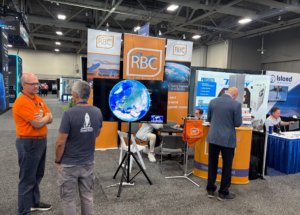
RBC Signals once again attended the SmallSat Conference in Salt Lake City. SmallSat is always one of our favorite industry gatherings, giving us the opportunity to connect with customers, partners, prospective customers, and vendors. We also hosted our well-attended annual side meeting, where participants discussed the current state of Ground Station as a Service (GSaaS) and the trends shaping its future.
Several themes stood out at this year’s conference.
A growing focus on execution
Several years ago, much of the conversation at SmallSat centered on exciting possibilities and what small satellites might someday accomplish. Today, the emphasis is increasingly on execution: building, launching, and successfully operating satellites in space.
Small satellites were once dismissed by some as “crap sats”—spacecraft considered too small to deliver meaningful value compared with larger, traditional satellites. That perception has changed dramatically. We are now seeing constellations execute increasingly sophisticated and valuable missions, demonstrating that smaller spacecraft can deliver significant commercial, scientific, and national-security capabilities.
Greater diversity of missions
In the conference’s earlier years, much of the focus was on communications, Earth observation, and scientific missions. Those applications remain important, but the range of mission types—and the orbits in which they operate—has expanded considerably.
Emerging and growing applications include payload-carrying orbital transfer vehicles, signals intelligence, in-space servicing, space domain awareness, and on-orbit computing. This diversity reflects both the maturation of the small-satellite sector and the increasingly central role that space-based infrastructure plays across industries.
Strong demand for launch and connectivity
Access to launch remains a significant industry challenge. As the market anticipates the future availability and capacity of Starship, even well-funded satellite manufacturers can face difficulty securing the right launch opportunity on the right timeline.
The industry is looking to providers such as Rocket Lab, Blue Origin, European launch companies, and Indian launch providers to expand capacity and increase launch cadence. A more diverse and dependable launch ecosystem will be essential to supporting the sector’s continued growth.
Every satellite placed in orbit must communicate with the ground—both for command and control and to deliver valuable mission data to end users. As more satellites and constellations become operational, we continue to see ever-greater demand for connectivity through both ground-segment infrastructure and intersatellite links.
Making the future of space real
One of the lasting impressions we take away from SmallSat each year is how supportive companies in this sector are of one another, even when they compete.
Space is hard, but its future is extraordinarily promising. SmallSat brings together the excitement surrounding that future, the practical focus required to make it real, and the collaborative spirit that continues to distinguish the space industry.